

Luiss Guido Carli University has inaugurated the new 2025–2026 Academic Year with a ceremony dedicated to the future of Europe, international transformations and the role of artificial intelligence in education. The event took place in the Aula Magna of the Viale Pola campus in Rome, in the presence of the university's leadership, students and institutional and economic guests.
The ceremony marked the official opening of the 2025–2026 Academic Year at Luiss Guido Carli University, with a focus on Europe in its legal, institutional and economic perspectives. At the heart of the event was a discussion on the changes redefining the European and international framework and on the responsibilities of universities in educating new generations.
Among the guests of honour were Giovanni Amoroso, President of the Constitutional Court, and Carlo Messina, Managing Director and CEO of Intesa Sanpaolo. Their contributions brought to the debate the perspectives of the institutions and the financial system on the challenges facing the European Union and Italy.
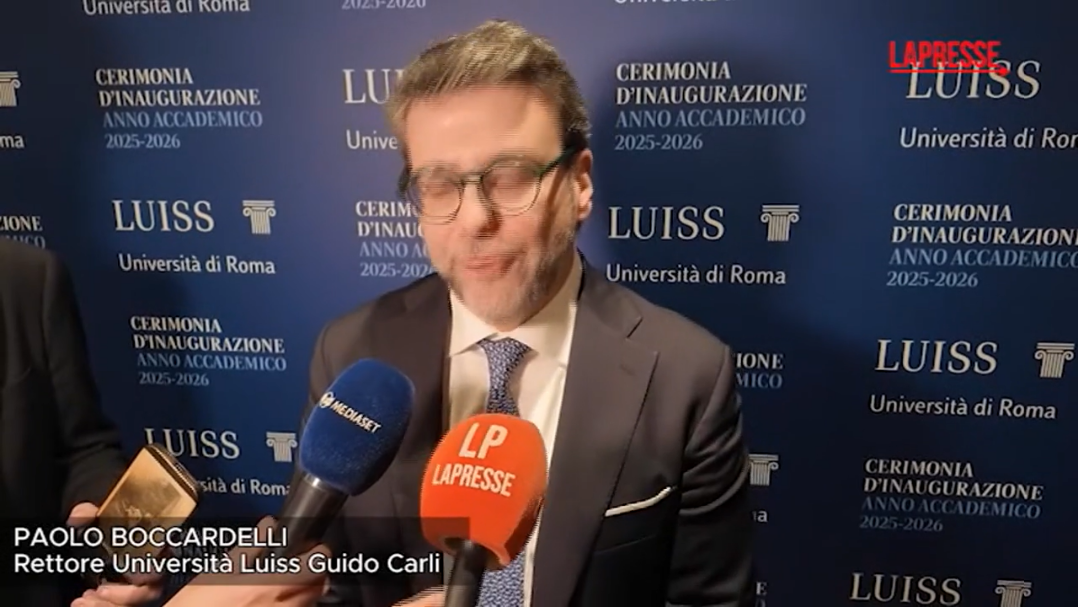
In his opening speech, Rector Paolo Boccardelli described Europe as immersed in a complex and structural phase of transformation. Geopolitics, industrial and technological transition, sustainability, demographic and social changes were identified as the factors reshaping the balances that have underpinned stability in recent decades.
Boccardelli emphasised that Luiss cannot limit itself to observing these processes, but is called upon to "take the field" by virtue of its mission and identity. The university aims to strengthen educational innovation, research and training programmes capable of preparing students oriented towards the common good, with the goal of contributing to the construction of Europe's future through advanced skills and civic awareness.
One of the central themes of the ceremony was the definition of a new "architecture of knowledge" within the university. Luiss aims to rethink educational models, skills and teaching methods, including the role of artificial intelligence in learning processes and course design.
The university intends to integrate digital tools and AI-based solutions to make learning pathways more effective and to develop transversal competences required by the labour market. This also includes interdisciplinary programmes and greater interaction between legal, economic, political and technological disciplines.
Another strategic focus presented concerns the promotion of a new "Italian and European industrial Renaissance". The objective is to strengthen the link between academic knowledge and practical know-how, with particular attention to relations between universities, industry and the business world.
Collaboration with Confindustria is indicated as one of the tools for consolidating this alliance between education and the productive fabric. Through structured partnerships, the university aims to foster the development of applied skills, joint projects and pathways that accompany students towards a conscious entry into the world of work.
During the ceremony, the strengthening of the university's international dimension was reiterated. Luiss aims to build new academic alliances and achieve a more prominent presence in the main channels of European university cooperation.
Among the examples mentioned was the Italy–France academic channel activated with Sciences Po, which represents a model of structured collaboration between universities. Through shared programmes and joint pathways, these partnerships aim to train profiles capable of operating in European and multi-level contexts.
Giovanni Amoroso, President of the Constitutional Court, focused his speech on the relationship between the Italian Constitution and the European Union. His reflections concerned the role of the Court within the current framework of EU law, with attention to the points of intersection between domestic law and EU law.
Amoroso analysed the mechanisms through which constitutional case law engages with European norms, highlighting the spaces for dialogue and the tensions that characterise the evolution of the legal system. In this context, legal education is presented as a decisive factor for understanding the complexity of the multi-level dimension.
Carlo Messina, Managing Director and CEO of Intesa Sanpaolo, focused his speech on the economic challenges affecting Italy and Europe. He described this phase as a potentially decisive moment for building a more solid growth perspective at the European level.
Key points included the possible strengthening of common European debt and the unification of markets as levers for shared growth. Messina highlighted Italy's strengths: political stability, careful management of public accounts, diversified manufacturing system, widespread savings and a solid banking system, considered the basis for sustaining investments and development.
A central passage was dedicated to human capital, identified as a decisive element for the country's competitiveness. Talent, creativity and adaptability were presented as the factors distinguishing the Italian system, with a call to listen to and support young people in their aspirations, recognising their energy as a key to sustainable growth.
The ceremony was concluded by the address of Luiss President Giorgio Fossa, who reiterated the university's role as a place of education and social responsibility. The task of the university was described as going beyond the mere transfer of skills, orienting itself towards preparation for the world in all its dimensions.
Fossa emphasised the importance of a stable alliance between the productive, institutional and university systems. Only structured collaboration can transform knowledge into vision and vision into progress, in a European context where the quality of education is closely linked to the ability to innovate and interpret global changes.