


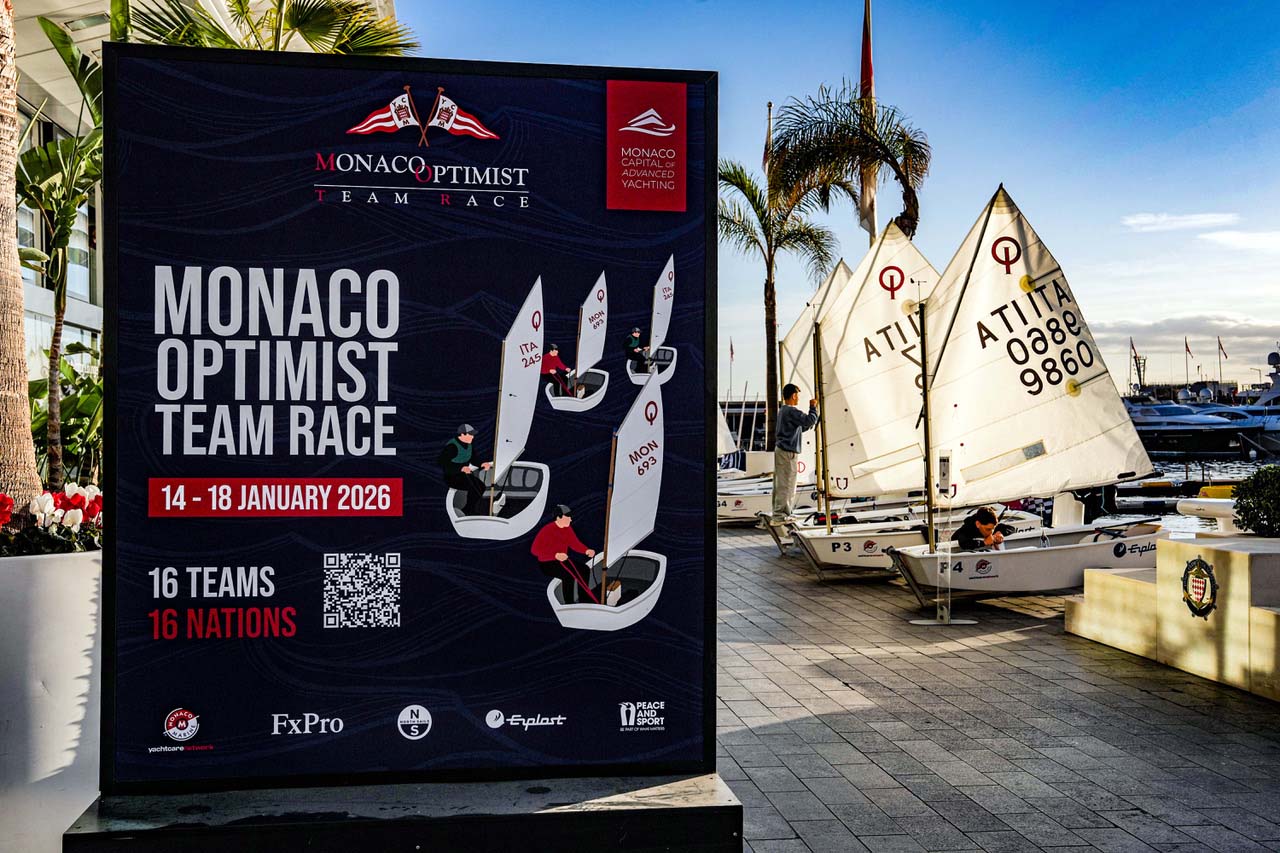
The Monaco Optimist Team Race 2026 started at the Yacht Club de Monaco, establishing itself as one of the benchmark youth regattas in the international calendar. On the first day of racing, fifteen teams of young sailors from twelve countries faced each other on the water to advance through the group stage and qualify for subsequent rounds. The event brings together boys and girls under 14 years of age and brings to the Principality the global elite of the Optimist class, with a format designed to place teamwork and technical growth at the center.
The Monaco Optimist Team Race adopts the team racing format, a discipline that privileges strategy, communication, and situation management over pure speed alone. Each team is composed of four helmsmen who compete in short and fast-paced races, in a series of one-on-one matches between teams.
The event structure includes a "round robin" group phase, in which all teams compete in a complete bracket; subsequently, the best teams advance to quarterfinals, semifinals, and finals, which represent the concluding moment of the event. The common goal for young sailors is to win as many matches as possible to move their team up the standings, while learning to make quick decisions in a highly competitive context.
According to international judge Chris Atkins, sailing offers young people a unique opportunity: at 10, 11, or 14 years old they can take a plane, reach another country, and compete in racing against peers from different continents and cultures. On the water, young sailors become captains of their own boats, assume control of maneuvers, and are called upon to make all decisions in real time, in an international and multilingual environment.
This dimension puts them face to face with sporting and relational responsibilities that go beyond any single regatta: they must coordinate with teammates, interpret the racing course and adapt to weather conditions, building skills useful even outside of sport. The emphasis on teamwork, typical of team racing, leads them to look beyond individual results to focus on collective outcomes, a concept central to higher sailing classes and yachting in general.
Alongside the regattas, the Monaco Optimist Team Race is accompanied by an international clinic led by Chris Atkins, a world reference figure in team racing with over 45 years of experience. Three-time winner of the British National Squad Racing Championship, former selector of the British Olympic team for Beijing and London, and World Sailing arbitrator, Atkins oversees specific work on tactics, technique, and management of racing situations.
Over three days of training, the teams involved have the opportunity to perfect maneuvers, refine decisions in crossing situations, and gain a deep understanding of the peculiarities of the team race format, from racing priorities to penalty management. The stated objective is not only to improve technical level, but to allow each athlete to return home as a more conscious sailor and person, with tools useful for future career stages.
For the Yacht Club de Monaco, the Monaco Optimist Team Race is a cornerstone of its sporting strategy, which aims to promote team spirit, discipline, self-control, and respect for rules among the young. The club hosts the teams, provides facilities and logistical support, and promotes dialogue between members of its own Sports Section and foreign delegations.
According to general secretary Bernard d'Alessandri, the competition has a value that goes beyond any single edition: today's Optimist sailors are tomorrow's sailors, and learning to work for team results is fundamental in a discipline where, as you move up in category, the presence of numerous crews on board is the norm. In this context, Monaco positions itself as a permanent laboratory for the new generation of sailing.
The 2026 edition confirms and strengthens the international profile of the regatta: fifteen under-14 teams arrive from twelve nations, from Uruguay to the United States, passing through Ireland, Italy, and various European countries. The variety of origins creates an environment of cultural exchange that accompanies the sporting one, with delegations sharing days on the quay, technical briefings, and moments of dialogue outside the water.
For the participating federations and clubs, the Monaco stop is considered a strategic passage in the training path of their young sailors, both for the level of opponents and for the quality of organization and racing conditions in the bay of the Principality.
Since 2010, the Monaco Optimist Team Race has built a record that reflects the progressive expansion of the participant base. In an early phase Switzerland often prevailed with the Société Nautique de Genève and the Gstaad Yacht Club, to which were added over time victories by teams from Germany, Finland, Turkey, and Monaco itself.
In more recent years, American participation has emerged strongly, with victories in 2020 and 2022, while in 2023 Croatia achieved a surprise with the JKU Deep Blue team. Each edition has highlighted a new reality capable of imposing itself at the highest levels of youth team racing, confirming the event as a privileged observatory on the future protagonists of international sailing.
For four days, the Monaco Optimist Team Race transforms the stretch of sea in front of the Yacht Club de Monaco into a training ground for young sailors, where technique and strategy intertwine in a highly formative context. Through the team race format, the international clinic, and competition between teams from multiple continents, the event helps prepare a new generation of sailors accustomed to competing in complex scenarios, communicating in teams, and making quick decisions in varying conditions.